Coffee Blog » How to Make Good Coffee at Home – on a Budget.
How to Make Good Coffee at Home – on a Budget.
By: Kev | Updated On: May 20, 2024 at 5:29 pm
So now lockdowns are a hazy memory, what the heck was that all about? Masks… social distancing, staying at home, was that all a dream? Isn’t it weird how there’s always something HUGE and scary to take up our attention?
Anyway, how to make good coffee at home is still a very important subject, even now that you’re not confined to your home, why drink coffee at home of a lesser quality than you have to? Also with the current situation in 2024 with the energy pricing going nuts as a result, you’re probably looking at ways to save money, and drinking more great quality coffee at home is of course one way to do that.
Although with that I would say, don’t forget to support your favourite coffee shops, and restaurants, as much as you possibly can. The hospitality industry is still on its knees since the lockdown days, so if we want our beloved coffee shops and restaurants to be open when we feel like paying them a visit, we do need to keep on supporting them.
Anyway, this post is about upgrading your home coffee. I’m talking about turbo boost level here, not slight improvements.
I’m not talking about making an acceptable coffee. I’m definitely not talking about instant coffee. I’m talking about how to make REALLY, REALLY good coffee at home.
I’m going to talk you through making fantastic tasting coffee at home, within your budget. Regardless of how much you have available right now, there’ll be a method here that you’ll be able to use to make really good coffee from home.
The art of making really good coffee at home can be broken down into 3 simple steps.
Step 1: Buy Good Coffee.

Some people are under the impression that the difference between speciality coffee and “normal” coffee, is just a poncy label or a fancy bag. It really isn’t. The difference between speciality coffee and commodity coffee (aka normal coffee), is, even more, real than the difference between “fine wine” and “cheap plonk” or “craft beer” and (insert your own cheap tasteless beer brand here, I don’t want to get sued).
I’m not wanting to put down “normal” commodity coffee, by the way. I was brought up on the stuff, and it’s saved me from lack of coffee on so many occasions throughout my life, including on the set of Benidorm – when I’d not had coffee for hours, and I was introduced to a huge urn of the most bitter crap tasting coffee I’ve ever tasted, and it was amazing ;-). It almost took off the roof of my mouth, like liquid marmite. Not particularly friendly on the taste buds, but I really needed that coffee so it was very welcomed.
I’ll explain in another post what the heck I was doing on the set of Benidorm, by the way – but it’s just another surreal situation I’ve found myself in over the years ;-). Not as surreal as being in a mansion in a gated, guarded community in Orange County California with three scantily clad bikini models and an ex-Chippendale. I’m not joking by the way, but it’s not as seedy as it may sound ;-).
Anyway, getting back to coffee. Speciality coffee is coffee which has been deemed high quality enough by the speciality coffee association, basically. There are folks with seriously sensitive and well trained coffee palates, known as Q graders, who taste the coffees and score them, and only the best tasting coffees can be classed as speciality coffees.
This really is special coffee.
It’s different from normal coffee, from where and how it is grown, to how it’s processed, how it’s exported & how it’s roasted. The reason most people in the UK think that “coffee just tastes of coffee” – is that they’ve been brought up on commodity coffee, as I was. Most of that coffee does taste generically coffee like. There are differences between one brand and another, but it’s similar to comparing shades of magnolia vs comparing all of the colours of the rainbow. It’s only once I started getting into speciality coffee that I began to realise just what a huge spectrum there is when it comes to coffee flavours.
So step one, is to buy freshly roasted, speciality coffee beans. You can find lots of small batch roasters on the coffeeblog coffee roasters directory.
It would be really silly of me at this point, not to introduce you to my own coffee website ;-). The Coffeeworks started off as a little project in which I asked my Fellow coffee botherers (coffeeblog readers, so that’s you now) to help me to decide what to do at every step including which flavour profiles to look for in the small range I was developing.
The Coffeeworks has since developed into a range of 19 lovely freshly roasted coffees, including amazing single origins and some stunning blends. Try them for yourself, use the discount code below as a new customer for 25% off, and as you’re a fellow coffee botherer after this first order use the discount code coffeebotherers for a permanent discount.
Step 2: Grind Your Own Coffee.
You might think that step 2 after the coffee, would be the coffee maker, but no – regardless of which coffee maker you decide to use, the most important step after buying great quality coffee, is to grind it yourself.
Grinding your own coffee is what really makes the biggest difference to the quality of the cup. The reason for this is freshness. The fresher your coffee, the better. Using freshly roasted coffee beans (roasted within 1-4 weeks from when you use them being the best date range to go for in my humble opinion), freshly ground, is a combination which leads to great cups of coffee.
Literally, as soon as coffee beans are ground, they start to lose their freshness – and I’m talking from the minute they’re ground, not hours or days. Coffee is an amazingly complex entity – with over a thousand different chemical compounds, and not even the most sciency scientists fully understand why it does what it does to us, the mood enhancement, the energy boost, and all of the health benefits that are now being discovered by study after study.
But all of this good stuff is within the structure of the coffee bean, and once it’s roasted and then ground, so much more of this good stuff in the coffee is exposed to the air, that it’s obvious that a lot of these compounds, including many of the compounds that deliver coffee’s flavour, aren’t going to be as potent after they’ve been ground and sat in a bag for a while.
So I’d highly recommend that you buy a coffee grinder.
At The Coffeeworks I did start out with a strict policy of whole beans only, but I backed down in the end and agreed to supply pre-ground as I was being asked for it so often, but The Coffeeworks pre-ground isn’t like most of the pre-ground coffee available, as we grind it to order. When you place your order, we grind it to your required grind level as we’re bagging it up, to ensure the freshest coffee possible.
Still, I’d recommend grinding your own coffee beans if you can, it’s the best way to enjoy freshly brewed coffee, due to freshness but also because grinding your own gives you control over the grind size.
Grinders don’t need to be ridiculously expensive. I started off with a Hario Skerton hand grinder, for about £30. I got bored of using my hand to grind after a while ;-), and I just fitted a hand drill to it & removed the handle. There are plenty of hand grinders you can get hold of for £20 and upwards. For more on manual coffee grinders see:
Electric grinders don’t need to cost the Earth either. If you need a burr grinder, I’d avoid the “grinders” which have blades instead of burrs, as blades don’t grind, they slice. You can get the likes of the Delonghi KG79 or the Krups Expert grinder, from about £40/£50, but I’d highly recommend just spending a little bit more on one of the conical burr grinders on the market that you can usually get from around the £50 mark.
While the Delonghi & Krups grinders in my opinion are better than pre-ground, they don’t quite have “proper” burrs, they’re these “grinding wheels” as they’re referred to, which are blunt, in fact, the sharpest thing on them is the heads of the screws holding them in place. They’re OK, but there are a load of grinders starting at the fifty quid mark which all have similar (around 38mm) conical steel burrs, which in my humble opinion, do a better job than these ultra cheap burr grinders with the blunt grinding wheel things.
For more on electric coffee grinders, see:
Step 3: Choose your weapon(s).
By weapons, I’m of course referring to coffee makers. I’m going to start off talking about espresso machines because many people looking to make good coffee from home are thinking along the lines of espresso. But, if you’re not interested in espresso, fear not – I’ll get onto other brew methods shortly.
Bean to cup espresso machines
If you want espresso at home, but you don’t want to embark on a hobby, then bean to cup may be the way forward for you.
Most people don’t realise that operating an espresso machine takes skill, there’s a real learning curve – nobody is going to get an espresso machine out of the box and start making amazing espresso from day one, without investing time and effort into developing home barista skills.
Trust me, your first shots as a home barista are likely to disgust you ;-), but in my opinion, it’s worth the investment as long as you enjoy the process, and I don’t think everyone would.
Some people just want to be able to press a button and get espresso – and if you’re not concerned about perfection, and being able to continually hone your skills and improve the quality of your espresso, then a bean to cup espresso machine is probably a good option.
Traditional Espresso Machines
With a traditional espresso machine, you have an espresso machine and a separate grinder. There are also integrated espresso machines such as the Sage Barista Express & sage barista pro, which are not bean to cup machines (even though bean to cup machines also have integrated grinders, there’s more required to make a machine a bean to cup).
We have Achille Gaggia to thank for the modern espresso machine. His first machine “Lampo” was the first espresso machine to not brew with steam, but it’s his lever piston machine invention that really is the father of modern home espresso machines.
The first home piston espresso machine was the Gaggia Gilda, and the piston via the lever was used to generate the pressure, rather than the lower pressure from the steam boiler as with earlier espresso machines.
Piston home espresso machines, known as fully manual traditional espresso machines, are still going strong – such as the La Pavoni Europiccola.
They’re a great machine to use, they give you so much control over the shot – although that’s only a good thing if you’ve developed some skill. A complete novice using a fully manual machine is going probably going to experience some frustration, and some terrible espresso to begin with until they’ve honed their home barista skills.
Most people reading this post though, are likely to be thinking of semi automatic espresso machines when they think of home espresso machines. These machines have a pump to produce the shot pressure, instead of using a lever & a piston.
While a quick search for a traditional espresso machine will deliver a tonne of results, just keep in mind that the vast majority of “espresso machines” are what I refer to as cheap domestic espresso machines, and not as home barista espresso machines. The difference is that the cheap domestic machines, usually ranging from about £80 – £150, are geared up for using pressurized baskets.
This is where the confusion can come with cheaper coffee grinders that are marketed as being espresso capable, as many of the sub £100 coffee grinders are capable of espresso, but only with pressurized baskets.
This kind of machine is really for the “normal” coffee drinker who wants a slightly more authentic espresso-making experience than pushing a button on a bean to cup coffee machine will provide, but while not requiring the same kind of home barista learning curve as with using a true home barista espresso machine.
Just keep in mind that if you do want the home barista end of things, the entry-level for that kind of espresso machine is the Sage Bambino Plus & the Gaggia Classic Pro. While both of these machines can be used for “normal” users as they come with pressurized baskets, they’re both also very capable as entry-level home barista machines and come with standard baskets too.
Filter Coffee Machines.
I do like a nice cup of filter coffee – as long as it’s great coffee of course, freshly roasted, and freshly ground. I’ll be talking about manual drip filter shortly, but first of all, I want to talk about filter coffee machines.
Some people will associate filter coffee machines with bitter tasting coffee. There are a couple of reasons for that. One is that most people who’ve experienced coffee via a filter coffee machine, have experienced commodity coffee, not speciality coffee – and, pre-ground.
In addition, many people have experienced filter coffee which has been sitting in the carafe on the hot plate, and some hot plates on earlier filter machines were pretty hot, which led to jugs of coffee getting more & more bitter the longer they sat for.
In the early to mid-00s, I started a business. I had a little office in a big business centre, anyone who visited me there within the year or two before I moved into bigger premises will remember the strong smell of bitter coffee. I used to buy big tins of pre-ground coffee make big jugs of the stuff and leave it there keeping warm on the hot plate.
This is the classic kind of coffee experience many will associate with filter coffee – as is the training courses I used to go on with my first “proper” job, which was mainly in hotel conference suites and involved bitter filter coffee sitting on warming plates.
But this doesn’t have to be the kind of experience you have with a filter coffee machine. Get freshly roasted speciality coffee, get a manual coffee grinder or an electric burr grinder, and you can make really good coffee at home with a filter coffee machine.
Again I am shamelessly going to plug The Coffeeworks, click on the link below to receive your 25% discount for your first order.
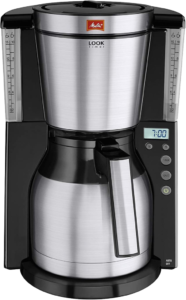
This machine has a timer, so you can set it to turn on and start brewing your coffee when you want it to be ready, which is a feature shared with other filter coffee machines, but what impresses me about this machine for such a cheap machine – is the insulated carafe instead of a hot plate.
I think it’s a far better idea to have an insulated jug to keep coffee warm than a hot plate, both in terms of being more eco friendly and stopping your coffee from deteriorating in taste while being kept warm.
If your budget is a bit bigger, and if you want really, really good filter coffee from home, I’d recommend having a look at the Sage Precision brewer. It’s not cheap – but it’s a really, really good filter coffee machine. So much so that James Hoffman, ex-world Barista champ & co-founder of Square Mile coffee has this as his home filter coffee machine.
For more information on the Sage Precision Brewer, please see this post:
It’s a huge 1.7 litre capacity filter machine, it has an insulated carafe and loads of other features – including the ability to swap out the filter holder with a V60 or Kalita, and that for me makes this a really special machine. If I wanted a filter coffee machine at home, it would be this one, without a doubt.
For more on filter coffee machines, see:
Pourover Drippers
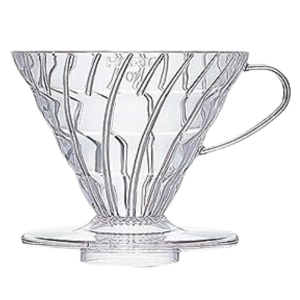
OK, enough about machines now, we’re onto the manual coffee makers – starting with pourover drip filter. Pourover drip is the manual way to make filter coffee, basically. Instead of the water being heated and poured through the ground coffee automatically, it’s done by the user.
So for pourover, you just need a filter holder and a filter. There are lots of options, but the most popular are Hario V60 & Kalita Wave which are both filter holders that can either be used as single cup machines, by simply putting the filter holder over your cup, or you can buy them with a corresponding jug – and Chemex. Chemex is a one-piece filter holder and jug, and it has quite a following, as do Kalita Wave and V60, to be fair.
You can make some really good coffee with pourover – again, as long as you’re using great quality freshly roasted coffee, and grinding it yourself. Drip coffee tends to be cleaner than other brew methods, you’ll usually get a cleaner and lighter cup than with cafetiere and stovetop. I prefer to drink pourover when the weather is nice if that makes sense. If it’s cold and wet, I’m more likely to crave cafetiere coffee if I’m not drinking espresso, Americano or flat white.
As with all the manual coffee makers, there are many recipes you can follow, including the brew ratio (ground coffee to water), pouring method and duration, and more. Just type pourover recipes into Google or YouTube and try a few. Here’s the 2019 brewer’s cup winning pourover recipe:
Aeropress
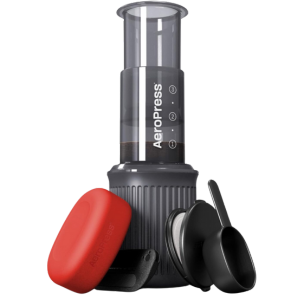
The Aerobi Aeropress was invented by the Aerodynamics expert Alan Adler, who invented the Aerobi flying ring – and it’s become an immensely popular brewer over the past 15 years.
Don’t get confused and buy the Aerobi, I reckon the flying ring will do about as good a job of brewing coffee as the Aeropress would do in a flying disk throwing competition ;-). The Aerobi flying ring still holds the world record for the longest throw, since 1984. Impressive!
But going back to the Aeropress, this is a really great little coffee brewer. It’s versatile, not only in terms of the various different recipes you can follow, but you can even use it in various different ways, namely the standard or inverted method. The standard method simply involves putting the Aeropress on top of the cup, putting in the ground coffee, pouring in the water, stirring (with the stirring paddle that it comes with) and then plunging. The inverted method, on the other hand, involves starting off with the plunger engaged, upside down, and leaving the coffee to brew or steep, for however long the recipe dictates.
I’m a huge fan of Aeropress, I use this brewer a LOT, and I really enjoy Aeropress coffee. You can use Aeropress to make espresso style coffee, concentrated, and then dilute it with hot water for Americano or Lungo, or with hot milk to make milkies such as cappuccino, flat white, Latte – or at least a version of, since it’s espresso style coffee as opposed to being actual espresso.
Actually, this is how Alan designed the Aeropress to work. He designed it to make espresso style coffee, to either be enjoyed like that or to be diluted with water or milk.
But you can also use the Aeropress inverted, introducing more – or all of the brew water with the ground coffee, rather than diluting – and for me, this method produces a kind of coffee which is somewhere between cafetiere and pourover. You can even change the quality of the coffee with the choice of filter. If you use the super fine paper filters that come with the Aeropress, you’ll get a cleaner cup, more along the lines of pourover – but if you use one of the various metal reusable filters available, depending on how fine it is, you’ll get a slightly different coffee in the cup. As I said, it’s a versatile brewer.
It’s also a very low cost brewer, they’re only about £30 – and that is including a branded bag, and 350 filters – which is enough to make around three and a half thousand cups, by the way! I re-use my filters, not because I’m a cheapskate 😉 but because I find the coffee tastes just ever so slightly better with a used filter than with a fresh one – so I’ll use the same filter until it starts to fall apart, and that’s usually around 10-12 uses.
With your own grinder and great quality coffee beans, you’ll be able to make really good coffee at home with the Aeropress, with very little learning involved.
Stove top or Moka pot
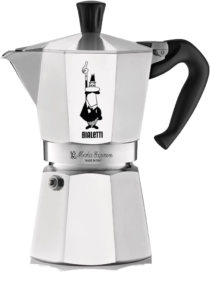
Stove top coffee pots, also known as Moka pots – or simply as “Bialetti”, are a great way to make really good coffee from home on a budget.
These little things have been an icon of Italian culture since the mid 1930s. This coffee brewer was invented by Alfonso Bialetti, who apparently took the idea from the laundry methods at the time in Italy, which involved tubs with a central pipe, which drew up the hot soapy water and distributed it over the laundry.
Not only did this little idea prove to be a good one, but it quickly became the most popular home coffee maker in Italy, owned by apparently 9 in 10 Italian households, and has become one of the best selling coffee makers in the world.
Moka pots make something similar to a lungo in strength, it’s not as strong as espresso – generally speaking, but it’s usually stronger than pourover for example.
There’s no doubt you can make some decent coffee with Moka pots. I mean come on, if they’re in 90% of Italian households… They tend to end up in the back of cupboards though, which is a shame, and it’s simply because people don’t tend to know how to use them, and that can easily lead to bitter coffee.
The main causes of bitter coffee with a Moka pot, are using coffee too finely ground, brewing with cold water, not keeping the pot clean, and not keeping the rubber seal clean and in good condition (store it loosely sealed, not tightly sealed, that will help the seal to last longer), and leaving it to brew too long after the gurgling sound begins.
Watch this video below for really good instruction on brewing great tasting coffee with a moka pot.
As with all of the other brew methods, use great quality coffee beans, grind your own, use scales and try tweaking your recipe and your grind, and you will be able to make really good coffee at home on a budget with a Moka pot.
Cafetiere or French Press
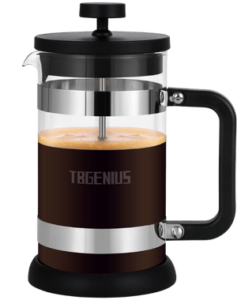
The cafetiere is a coffee brewers already present in many UK kitchens, so this suggestion may well not require any spending at all. Having said that, most people who own a cafetiere would use pre-ground coffee, so a grinder will be one purchase you’ll need to make if you want to make really good coffee from home with your cafetiere.
If you’re going for cafetiere, you’re going to be grinding more coarse than for most other brew methods. The coarser the grind, the less grinding required, so grinding for cafetiere does make hand grinders a more obvious choice than with espresso for instance which takes quite a bit more effort.
This blog was inspired by a cafetiere, strangely enough! Back in 2015 my wife & kids got me a new stainless steel cafetiere – very similar to this one, although the exact one doesn’t seem to be available now – for my birthday. I bought a few bags of supermarket coffee, pre-ground, commodity coffee (I wasn’t into the speciality coffee thing at that time), I noticed that one of the bags of coffee I’d bought tasted vile via cafetiere.
This is a very well known brand of coffee, that back then I thought was decent coffee, so I wasn’t sure why it tasted like it did, given that I’d bought coffee pre-ground for cafetiere, and this is basically where my home barista journey began. I decided to start the blog at the time, to share my experience with others. I was talking to myself at first, I had no readers, but that was OK, writing this stuff was helping me to learn. I stuck with it, blogging about coffee became a habit – and 5 years later I’ve shared this journey with nearly one million different people via the blog, who’d have thunk it?!
As with the Moka pot, the humble cafetiere is a coffee maker which deserves more credit than it’s usually given. It can produce crap coffee, just like any coffee maker – if you put crap in, you get crap out. But it can also produce great coffee, if you use great coffee, and if you do a good job with the brew.
If your cafetiere is knackered, or if you don’t have one – just jump on Amazon and grab one. I honestly wouldn’t worry too much about which one you go for, generally speaking, they’re much of a muchness, especially if you’re wanting to spend something like £20/£30.
Just keep in mind that if you’re going for a glass one, make sure it’s the more durable Borosolite and not standard glass. I prefer the stainless steel ones myself as you don’t need to worry about them smashing, but keep in mind that re the “will keep your coffee hot” thing, in my opinion, you’re best brewing the coffee in your cafetiere and then keeping it hot by pouring it into a travel cup or a flask, so your coffee isn’t stewing as it’s being kept warm.
As with the other brew methods, you can work on your method and your recipe, and as long as you have a grinder, a cafetiere, and brew scales, you don’t really need much else.
My favourite cafetiere recipe is James Hoffman’s method below.
So there we go, if you were wondering how to upgrade the quality of your coffee at home, on any budget, you now know 🙂
Just remember, no matter the brew method(s) you decide on, for really good coffee at home you’ll need great coffee beans…
Life is like a box of chocolates, subscribe to my YouTube Channel, try my coffee at The Coffeeworks (use discount code CWNC25 for 25% off your first order), follow me on Twitter & Instagram, follow the coffeeblog FaceBook page, and that’s all I have to say about that.
Coffee Blog is proudly powered by WordPress