Coffee Blog » Sage Dual Boiler – The Best Dual Boiler Espresso Machine?
Sage Dual Boiler – The Best Dual Boiler Espresso Machine?
By: Kev | Updated On: September 13, 2024 at 8:45 am
The Sage Dual Boiler, or Breville Dual Boiler if you’re not in Europe, is an espresso machine I’ve been wanting to review for ages, and if you’re one of my fellow coffee botherers (what I call my readers and viewers) who have been asking me to review the Dual Boiler for ages, apologies for the delay!
The model I’m reviewing is the current model in 2024, by the way, which is the Sage Dual Boiler bes920UK.
Sage Dual Boiler Espresso Machine
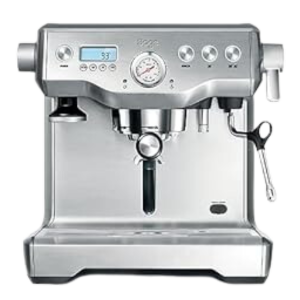
A quick note on the Sage vs Breville thing. These machines are made by Breville Worldwide, and they would be known as Breville here in the UK, except for the fact that they sold the brand name in Europe in the 80s. So machines made by Breville Worldwide (HQ is Australia) are sold in the UK under the brand name Sage, also known as Sage Appliances & Sage by Heston Blumenthal.
The Sage Dual Boiler probably should have been one of the first machines I reviewed, but to review machines in the order I wanted to work in rather than reviewing machines that manufacturers or suppliers were looking for reviews on, would have meant buying espresso machines myself.
As you can probably relate to, when it comes to buying expensive espresso machines it’s not only affordability that can hold you back from buying the machine you fancy, justifying the cost of such an expensive machine to significant others can also be a real challenge.
To someone who hasn’t caught the home barista bug, or to someone who doesn’t even drink coffee, spending hundreds or even thousands on a coffee machine must seem very odd, I get that.
Trying to convince my wife (who doesn’t drink coffee) when I’d just started the blog, that I needed to spend over a grand on an espresso machine, would have gone down like a brass blimp!
I reviewed the Sage Oracle not long after starting the blog, but that was because Sage had a demo machine doing the rounds at the time, and they were kind enough to trust me with it for a couple of weeks on loan.
It really was kind of them, thinking back to when I got in touch with them. The blog was brand new at the time, they didn’t know me from Adam (who’s Adam?), and they can’t have known that the blog would take off as it did, that took even me by surprise!
Anyway, I’ve used and reviewed various other Sage coffee machines over the past few years, but the Sage Dual Boiler is the one that has got away until now.
Recently though I’ve decided it’s really daft that even though I know the Sage Dual Boiler is one of the best home barista espresso machines on the market, I still haven’t used it and reviewed it, so rather than waiting for Sage to send me a demo unit, I decided to buy one, so I can use it and review it over a long period of time as I did with the Bambino Plus review.
I can justify such a purchase these days, given that I make my living from writing about coffee machines ;-), although I can never bring myself to call what I do now “work”.
Sage would have sent me a demo model, but buying one myself means I can use it and review it over a longer period of time, and also means I can do some modding, which I’m planning to feature in some future youtube videos and blog posts, but more on that shortly.
My Sage Dual Boiler Review in a Nutshell
If you’ve been here before, you’ll probably know that my blog posts tend to be quite long. I don’t apologise for that ;-), I love writing, and this often means my posts end up much longer than they would be if I just got on with it.
But I do definitely appreciate that some people don’t want to read about a machine in quite as much detail as I tend to go with my reviews, and just want me to cut to the chase, so if that’s you – you don’t need to read the full review post, here’s my nutshell review:
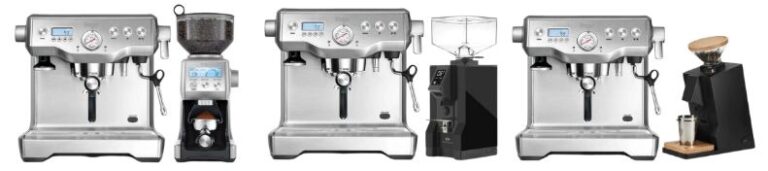
It's amazing buy it! BUT see: Dual Boiler Bundles.
OK, that’s not really my nutshell review ;-), but it is my overall opinion – as long as you’re looking for a home barista espresso machine, not bean to cup.
There’s really not much that competes in terms of these kinds of features for this kind of money – and its already very good value for money, but some of the grinder bundle deals represent amazing value for money for packages that are capable of delivering amazing espresso! Just click here to jump down to my section on the bundle deals.
Here's my real nutshell review:

Taking everything into account, I think the Sage Dual Boiler is an incredible machine, and that it’s potentially the most perfect espresso machine I’ve ever used.
I think it’s a brilliant machine regardless of your home barista skill, being just as good a choice for seasoned home baristas as for folk who are yet to pull their first shot.
This is a machine which is very simple to use and amazingly user friendly, but at the same time, it has really advanced potential that the home barista can unlock as he or she develops their skills, due to the level of control (in some cases unrivalled, certainly at this price) that this machine gives over certain aspects of shot pulling.
So this is a machine that you could start with, and grow with – rather than starting with a more entry-level machine and then upgrading. There’s one for you if you’re looking for ways to justify this purchase to the boss ;-).
The benefit of this over the more common approach of going for an entry-level single boiler or thermoblock machine is that although it’s mega user-friendly and simple to use, it’s also very temperature stable, thus removing one of the common hurdles (temperature instability) of using a more entry-level machine which can make things more complex & lengthen the learning curve.
Here’s a list of the main features off the top of my head, along with an explanation of what this actually gives you:
- Dual Boilers | Pull shots and steam milk simultaneously
- PID controlled (adjustable) brew boiler | Gives you temperature control and stability
- Heat exchanger | for better temperature stability
- Temperature-controlled steam boiler | Instantly available steam with adjustable pressure
- PID controlled Heated group head | Increases temp stability, stops the group head zapping the temperature of the coffee
- Easy (via LCD) adjustment of brew temperature with a range of 86 – 96C | Allows you to get the best result with different roast profiles
- Programmable timed shot buttons | Allows you to control how long the shot flows for, very handy.
- Programmable volumetric shot buttons (toggle between timed and volumetric via the LCD) | In theory, this gives you better shot repeatability
- Manual shot button | Allows you to bypass the shot buttons and pull shots manually on the fly
- Easy (via LCD) adjustment of pre-infusion time from 0-90 seconds | Gives you further control of the shot
- Easy (via LCD) adjustment of pre-infusion power (range of 55-99) | As above, further shot control but also in combination of the above this is a way to potentially pull some very special shots, but more on that later in this post.
- Timed auto on (via LCD) | This Means you can have your machine heated up and ready when you wake up
- Digital shot timer | Means you don't have to mess about using the timer on your scales
- Pressure gauge | Gives you a visual of the pressure being applied
- Pro steam wand on a ball joint | Gives you great access to the wand with the jug, and gives you various wand position options
- Steam lever, rather than a rotary steam knob | It's just easier, less effort, and I find it really satisfying using a steam lever
- Dedicated hot water spout | hot water for Americano / Lungo, and it's a needle valve which lends itself as a potential flow profiling mod (more on this later)
- Fast heat-up time | It's heated up in around 5 minutes, amazing for a dual boiler machine
- 2.5 Litre water tank, filled from the top at the front or by removing the tank from the rear | Big tank with different filling options means less filling and less faff.
- 1.2 Litre drip tray capacity – with an “Empty Me” indicator | Big drip tray means fewer trips to the sink to empty it, and the empty me indicator means you don't forget to empty it and end up with an over flowing drip tray. Why this isn't a standard feature I don't know
- Very visible, LED lit water level indicator | Again, why this isn't standard I don't know, but it's great to be able to see when you need to refill the tank
- Digital tank empty warning | So even if you don't notice the quite obvious fact that the tank is low, it'll warn you via the LCD
- Hidden moving wheel accessible under the drip tray | So when you do need to move it, to access the water tank, for example, you don't scratch your worktop or gain a hernia
- Fairly Compact at just over 37cm tall, wide and deep | Will fit in most kitchens or coffee corners without too much of an issue
- Internal cable tidy | So any cable not required is stored inside the rear of the machine, rather than looking messy
This isn’t an exhaustive list, it’s just the most obvious stuff off the top of my head. All this, and it’s one of the cheapest dual boiler espresso machines on the market!
Now for the bullet list of negatives. Are you ready?
Now for the bullet list of negatives. Are you ready?
- I can’t find any!
As you’ll know if you’ve read my other reviews, I review stuff very honestly, and I can always find the warts to make my reviews “warts ‘n all” – so far, I’ve never reviewed an espresso machine without being able to find some not so good stuff to talk about.
With the Sage Dual Boiler, though, I honestly haven’t been able to find any.
I’ve only used the machine for a few weeks, so I will talk about potential long-term issues later on in this post, but these are from research rather than from experience.
If you’re concerned about longevity, though, I should probably point out that the machine I’ve bought is over 6 years old, and has pulled around one thousand one hundred shots!
I didn’t buy a new one purely because I was planning to do some mods to it, and I thought I might break it ;-), I also wasn’t expecting to be so impressed with it to the point that I wanted to keep it!
See my Dual Boiler review on youtube:
I bought it from an independent espresso machine engineer who reconditions them. I picked his brains for technical info on the Dual Boiler when I went to collect, and the things he told me really gave me a lot of confidence about this machine when it comes to longevity – and my research since then has backed up what he told me.
Going back to my personal experience with this machine so far, the only negative thing I can mention is something beyond Sage’s control, and something you’ll find on other recently manufactured home espresso machines, which is the 15-minute auto-off due to this EC directive.
I’ll talk a bit more about this later, but by using the auto-on function and being a little bit more organized, this auto-off function could be a very good thing for the environment, although that’s not what I muttered under my breath the first time it turned itself off ;-).
Other than this though, nothing negative to report.
The only way I’d be able to find negatives is by comparison, but only by making unfair comparisons. For example, it’s obviously a lot bigger than the Bambino Plus, so by that comparison it’s big.
It takes 5 minutes or so to warm up, so compared with the Bambino Plus and Barista Pro that’s slow. It’s around three times the price of the bambino plus and roughly twice the price of the barista express, so by that comparison, it’s expensive.
But as I say, that’s only by making unfair comparisons, as the Dual Boiler is a very different machine to the other Sage espresso machines.
If you compare the Sage Dual Boiler to other dual boiler machines when it comes to these areas, warm-up time, size & cost, the Dual Boiler would usually come out on top.
If you compare the Sage dual boiler to other dual boiler machines, particularly when it comes to temperature stability you’d have to search quite hard to find a machine that competes.
It has proven in many SCACE tests to be similar in temperature stability to saturated group espresso machines including the La Marzocco GS3, which is about six grand!
In terms of longer-term issues, obviously, I can’t know about such things from a few weeks of use, but I’ve done some fairly extensive research, and I can’t see a great deal of issues, and I’ll go to these in more depth a bit later on in this post.
Yes, if you look through the Amazon reviews, although it’s largely positive you’ll find a few scathing reviews from people who’ve had problems, and you always will do with any espresso machine.
There has been a “valve error” which has caused a bit of controversy in the past, which is where the machine gets its knickers in a knot during the descaling process, which you’ll find mention of if you do some googling.
I’ll cover this in more depth later in this post, but the long and short of it is to not let your machine get scaled up, as this appears to be caused by lumps of limescale being dislodged, usually during descaling, which stops the valves from working.
This is why it’s so important to refresh the filter often enough depending on your water hardness, and to keep on top of descaling, or better still if you’re in a hard water area don’t use tap water. This goes for all espresso machines. Any espresso machine engineer will tell you that the biggest cause of damage is scale.
The other thing I’ve seen a few complaints about is the plastic group collar insert.
This is a very inexpensive part, and in all likelihood, it won’t go on your machine within a few years of use. If you’re buying one reconditioned, though, then I’d ask the seller to confirm this has been replaced, but I’ll talk more about buying recons a bit later on.
If you’re buying a new one, I really don’t think this is something you need to be concerned with.
To be honest, I don’t think there’s anything you need to be particularly concerned with if you’re buying a Sage Dual Boiler brand new. They come with a 2 year warranty, if anything happens within this period you’ll be looked after.
I’d simply recommend that once you’re out of warranty, you find someone to give it a service for you, replace the standard bits, O rings and so on, to prevent any small wear and tear issues causing anything much bigger.
I’ve read a few complaints online about bigger issues, usually outside of warranty, and in many cases, I suspect that these have been caused due to very insignificant issues such as a worn internal O-ring leading to some internal leaking which then causes a much bigger problem.
So, either just before the warranty ends, or not long after, if you give it a once over or get someone to do that for you, and then just have this done on a yearly basis (maybe sooner, depending on how much use the machine gets) this should prevent any real issues from developing.
So in short, the Sage Dual Boiler is a stonking machine for the price, and I’ve determined this from a combination of spending a few weeks so far using the machine, and from a heck of a lot of research.
But Wait – is the Sage Dual Boiler the right machine for you?
I wanted to add this short section before I get into my more detailed review because I don’t want my enthusiasm for this machine to lead anyone to buy this machine if it’s not right for them, and it’s not right for everyone.
The first thing to keep in mind is that this is a home barista espresso machine – that is, it’s a traditional espresso machine, which will require home barista skills to operate.
I can understand why some people would look at the likes of the Sage Oracle and Oracle Touch, determine that these must be the best, and then look a bit closer to the middle in terms of cost, but that doesn’t work here because we’re talking about different types of coffee machine.
The Sage Oracle and Sage Oracle Touch are the same machines as the Dual Boiler in many ways, the same dual boilers, same triple heating system and so on, but there’s one major difference which is that the Oracle machines are aimed at bean to cup users, while the Dual Boiler is aimed at the home barista market.
Being a home barista is a hobby, it’s not just a case of buying a machine so you can press a button and get great espresso and espresso-based drinks, there’s a real skill to it, and this is a skill which takes time and effort to master.
See me on my youtube video from where I started to now:
If you just want to get a machine out of the box and press a button, meaning a coffee machine for you is literally just a means to an end, and you’d rather pinch yourself really hard somewhere soft than to start a new hobby – then what you need is a bean to cup coffee machine, not a traditional espresso machine.
Sage’s answer to bean to cup machines are the Oracle range, featuring the Oracle, and the imaginatively named touch screen version “Oracle Touch“.
They’re based on the Dual Boiler, and they’re capable of the same amazing quality espresso, but they’ve very cleverly built on-board barista skills into the machine itself so that you don’t need to develop them.
If you want a bean to cup machine but you don’t have the budget to stretch to the Oracle machines, there are plenty of “normal” bean to cup coffee machines which are available at much lower prices.
To explain what I mean by “normal”.
Standard bean to cup machines compromise quality for the sake of convenience, which is perfectly fine – for many, it’s a compromise worth making. The Oracle machines, though, provide the best of both worlds, the cup quality of traditional with the convenience of bean to cup.
The only downside is that the oracle machines aren’t cheap, there are many bean to cup machines which are much cheaper. For more on bean to cup machines see:
So with that said, let’s get on with the review in a bit more depth.
By the way – don’t forget that regardless of which machine you go for, you’ll need great quality coffee beans, in order to make great tasting coffee. Check out my coffee from Cworks, if you’re just getting started, I’d highly recommend starting out with chocolate brownie blend or chocolate fondant blend, they’re the easiest to dial in, and they have crowd pleasing flavour notes that most people who’re just getting into home espresso will love.
And I’ll put my money where my mouth is, with 25% off your first order :-).
Sage Dual Boiler Review in More Depth
OK so if you’re still reading this now and you’ve not already gone off to buy this machine, you’re obviously someone who likes to really do their homework ;-), which isn’t a bad thing.
Either that, or you just really enjoy reading my stuff and you can’t close this post ;-), and if that’s the case, excellent.
Small things
Sage (Breville worldwide, they’re sold as Sage in the UK as they sold the brand name here in the 80s) really are clever, they don’t tend to do things the same as everyone else. Instead, they tend to look at the way things are currently being done and ask if there is a better way to do it which may be more convenient & user friendly.
Some of these features with the Dual Boiler are there to improve coffee quality, things like the high level of control over brew temperature and pre-infusion.
Some of them seem like really small things and don’t relate to coffee quality, but they just make so much sense, you’ll wonder why all other manufacturers don’t do the same.
The cable tidy for example, I’m so used to having to try to tidy up cables on the worktop behind espresso machines, as the plugs are fairly close so I usually don’t need the full cable length available. This internal cable tidy seems obvious, but it’s not something I’d usually expect to see on an espresso machine.
The locking wheel is another example of this. It’s a fairly heavy machine, as dual boiler espresso machines tend to be, especially when the water tank is full, so being able to just turn a dial to then move it really easily, just makes sense, and it’s not a standard thing at all.
The tamper which slots into the tamper bay and is held magnetically, it just makes sense, you always know where your tamper is. Unless you forgot to put it back in there of course and put it somewhere daft.
The fact you can just push the front of the top of the machine and the flap slowly opens up, for you to fill the tank from the top – or if you prefer, you can just remove the tank from the back, again just little things like this make this machine so user friendly.
The little “Empty Me” paddle that pops up when the drip tray is full, it just makes sense, and you’d think drip tray full indicators would be a standard thing, but they’re definitely not.
The steam is started and stopped by a lever instead of a rotary valve. This isn’t something Sage invented, it’s something you’ll find on some commercial machines and some high-end espresso machines, but the vast majority of espresso machines have a rotary valve, and having a lever just makes so much sense.
The fact that it has an auto-on function, meaning you can set it to be ready when you wake up needing coffee, again this is something you don’t get on many espresso machines, and it just makes sense.
The storage tray behind the drip tray, allowing you to store bits like your other basket & backflush disk etc.
How easy they’ve made everything via the LCD, such as changing brew temperature, setting the preinfusion time and power, re-setting the shot button times or volumes if you choose to switch it to volumetric.
It’s unlikely you’ll use a Sage machine and think “hmm, It would have been better if they’d done this…” because if there was any better way of doing something, they’d probably have done it.
Bigger things
OK so Sage are great when it comes to the little things I’ve mentioned above, but there are some really big things they’ve innovated with the Sage dual boiler.
The dual boiler was a project that was around three and half years in the making. Phil McKnight and the Breville team set out on what they refer to as a “blue sky project”, which basically means a project without limits.
The standard approach to designing a new domestic espresso machine would be to try the best domestic machines on the market, reverse engineer them and look at making them slightly better. But for this project, the goal was “cafe quality espresso at home” and they did their research based on commercial equipment, not domestic.
What they ended up with was not just something unique to domestic espresso machines, but something I think which is fairly unique even to commercial machines, and the long and short of it is that you end up with ridiculous temperature stability at a much lower cost than would usually be required to achieve that.
At the heart of this espresso machine are a 950ml steam boiler, a PID controlled 450ml brew boiler, a heat exchanger and a PID controlled heated group.
Usually, you’d either have dual boilers, or you’d have a heat exchanger, it’s not usual to have both.
A heat exchanger is a pipe that runs through the steam boiler, utilising the heat from the boiler to heat the brew water.
Having dual boilers does away with the need for a heat exchanger, but what they figured out is that by using a heat exchanger, which is after all just a pipe so it’s fairly inexpensive, they can use the heat of the steam boiler to bring heated water into the smaller brew boiler to avoid the thermal shock of pulling in cold water.
Just like the little things, the cable tidy, the locking wheel & so on, this seems such an obvious thing to do, to help with thermal stability, but it certainly wasn’t obvious until they designed it.
Understanding that temperature stability is paramount, they didn’t stop here, they fitted a heating element to the group, and they fitted a temperature sensor in the group and a separate one in the brew boiler.
They then installed two PID controllers (PID: Proportional, Integral, Derivative – a very technical name to describe what is basically a way to control the temperature with accuracy and stability) which independently receive feedback from these temp sensors, allowing them to work together to ensure that the brew temp the user has requested, is the brew temp that is delivered.
This is a big thing, it gives you incredible brew temperature accuracy and stability.
If you’re using a lightly roasted bean, and you decide to up the brew temp to 96C for instance, when the LCD tells you you’re getting 96C, you’re going to be getting this temperature with almost unrivalled accuracy (unrivalled I’d say until you spend over double or possibly even triple the price).
There are a number of elements to getting a great shot of espresso, but one of the most important is brew temperature, if you’ve got that sorted, you’re a big jump towards perfect espresso.
I just thought I would mention ….again…my own coffee beans from The Coffeeworks. sorry but it would be such a shame to not try these delicious natural flavoured beans in your coffee, they really do taste great I know because you lovely Coffee botherers helped me to develop the most popular tastes. Just click on the link below.
Just having PID control doesn’t give you this level of accuracy. You can fit a PID to a Gaggia Classic or Rancilio Silvia, for example, but having a PID alone doesn’t give you the temperature stability or accuracy that this combination of technology and engineering inside the Dual Boiler provides. Also, the entry-level Sage machines including the bambino plus, duo temp pro, barista express and barista pro all have a PID, but they won’t provide this level of precision.
It doesn’t stop there, either. Something else Breville did which is really big, is when it comes to pump control.
By the way, just to add at this point, in case you weren’t aware and/or if you didn’t read this earlier in this post, what we know as Sage Appliances in the UK is known as Breville in most other countries, they sold the brand name in Europe in the 80s which is why we know of a different Breville here.
The pump in the Breville dual boiler is a fairly standard espresso pump, the Ulka EX5, which is a 15 bar pump used on various other machines.
But Breville being Breville, they weren’t just going to leave it at that ;-). They designed and patented a way to control the power of this pump, similar to using a dimmer switch, which allows the user to control not only the pre-infusion time, but also the pre-infusion pressure.
As well as being able to set the preinfusion time via the LCD (by pressing and holding the up and down arrows) within a huge range of zero to 90 seconds, you can also set the preinfusion power, and you can also determine the preinfusion manually by pressing and holding the “manual” button.
This gives you a lot of control over the shot and makes it possible to pull different shots to the usual zero or short preinfusion and a 25-30 second shot time
One of the opportunities this presents is to allow you to pull what is generally referred to as “Slayer like” shots, even without doing any modding. The Slayer being a brand of espresso machine with unique control over the pump pressure, which will set you back about ten grand.
With a machine like this which gives such control over pump pressure, you’re no longer restricted to the norm when it comes to pulling espresso, and it’s possible to pull some amazing shots with the Slayer.
You can pull similar shots with the Dual Boiler simply by changing the preinfusion power to the minimum setting of 55 (via the LCD) and then pressing and holding the manual button, which keeps the machine in pre-infusion until you take your finger off the button, which you’d do when you start to see the first drips of espresso.
For help with dialling in check out this video:
I’ve pulled some incredible “slayer-like” shots with the Dual Boiler, by doing the following:
- Grinding slightly finer than I usually would (At the moment I'm using my Cranberry & Pomegranate blend, at approx grind size 7 on the Niche Zero, and I'd usually be at around 9 for this coffee)
- Pre-infusion power set to the minimum, 55 – which you only have to do once but you can change back at any time (by pressing the up and down arrows together, then pressing menu to toggle to “PP”).
- Using a bottomless portafilter, because it looks ace, and it gives feedback on what's happening with the shot.
- Pressing and holding the manual shot button, aiming for the first drips at around 20 seconds.
- Releasing the manual shot button at that point, and continuing the shot at full pressure.
It’s also possible to go further than this and do what is known as flow profiling, with the help of a scale which gives you flow data such as the Acaia Lunar, and with a very simple (and free, and completely reversible) mod to the machine which enables you to control the pump pressure via the hot water knob.
I’ve found you can also back off the brew pressure really quite precisely without any mod, by simply opening the hot water valve very slightly while pulling the shot, and in theory, this does exactly the same, the only negative being that you waste some hot water.
If this is all starting to sound really complex, don’t worry about it, all you need to know is this machine has some really advanced capabilities if you get to the stage where you want to start giving them a try.
Why so underrated?
The Sage dual boiler, for me, is one of the most capable yet one of the most underrated espresso machines currently available in the UK. Why this is, well there are probably a few reasons, but I think the main things are:
1) The tendency for people to judge a book by its cover
2) It may seem too good to be true
Re judging books by their covers, the Sage Dual Boiler doesn’t look like most other prosumer, or home barista espresso machines.
Most people looking for a dual boiler espresso machine would expect to find something looking like this:
La Pavoni Botticelli
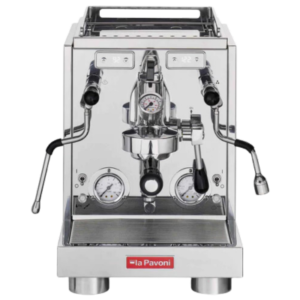
More seasoned home baristas will be more used to the look of traditional Italian looking (I say looking, as some of them, Profitec & ECM for example, are German made) machines, often with E61 groups.
The Sage Dual boiler looks more like the other Sage machines, which to some of the more experienced among the home barista crowd, might look a bit too much like a modern kitchen appliance, and not enough like a traditional espresso machine.
For some people, this is a blessing. If you have a tea-drinking partner (as I do – thankfully my wife likes the smell of coffee but doesn’t drink it, more for me.) they might not be best pleased about you spending the cost of a decent holiday on a machine that will take up half the kitchen worktop & looks like it might come to life and attack her while you’re out.
Sage machines, on the other hand, are made to fit in nicely in modern kitchens. They’re inoffensive to look at – they do look very much at home in a domestic kitchen. I think this is what offends the senses of some of the more hardcore home barista crowd who prefer their traditional espresso machines to look like traditional espresso machines.
Some will say they look cheaper too than other dual boiler espresso machines – but then, they are ;-), and they don’t look cheap to me, I’ve always really liked the look of Sage machines. Beauty is in the eye of the beholder, I think they say.
Re seeming too good to be true, the Sage Dual Boiler is a dual boiler machine, with a PID, with a heated group, and with a lot of other features, for around the price of an entry-level heat exchanger machine.
If someone launched a car that appeared to have all the same features as an Audi Q7 for the price of the Ford Mondeo, would you be sceptical? Well, you might not be, I might not be as I don’t know a thing about cars, but car enthusiasts would probably look down their noses at it for quite some time before finally accepting it if it’s for real.
This is basically what’s happened with the Sage Dual boiler. The home barista community has mostly come around to accepting this espresso machine now for the great machine it is for the relatively tiny price tag, with some of the most well known and respected folk in this arena having come out to sing its praises more recently.
Potential issues in more depth
I think it’s important to accept that regardless of what espresso machine you buy, there are going to be issues further down the line. Whether this is in 3 years, 5 years or beyond, at some time your machine is going to need some TLC.
One of the reasons the home barista community were probably sceptical, to begin with, is that when this machine was newer, no one had had one for long enough to understand if there were any potential long-term issues, and the price of this machine does seem a bit too good to be true.
It’s now been 10 years since the release of the Dual Boiler, so there are plenty of folks who’ve had these machines for long enough to have figured out the potential weak points and so on.
For a huge thread on this:
What has come to light from the Home Barista forums, also from threads on the UK coffee forums, is that in terms of the issues that are likely to need dealing with, mainly it’s just the normal stuff.
If you’re fairly comfortable with taking things apart, most of these things can be done DIY. If you don’t like getting your hands dirty, just have a look around to see if there’s an independent espresso repair engineer in your area.
The official repair firm in the UK for Sage are Coffee Classics, these guys are who Sage will refer you to, but being a bigger firm their minimum cost will probably be a bit over the top for standard stuff like swapping out o-rings.
The most common things are simply rubber seals and o-rings, which are just standard parts, very cheap & easy to get hold of and most of them are very simple to replace. The rubber seal on the group & the o-rings on the boilers are what most in the know will usually recommend you replace after a couple of years as part of ongoing maintenance, and to check for any leaks internally which may mean the replacement of other o-rings.
In addition to this, the solenoid valves can start to get a bit noisy, or “buzzy” after 5 years or so (making a loud metallic sounding buzz) but again this is a fairly cheap and easy part to replace.
Any espresso machine can develop bigger issues requiring major repair jobs, but from looking through the huge thread on the Home Barista forums and from speaking to engineers, I don’t believe you’re any more likely to encounter such an issue with a Sage Dual Boiler than any other dual boiler espresso machine.
Valve Error or “Valv Error”
As I mentioned in the nutshell review, you’ll find a few people complaining about this if you dig through Google results.
I’ve done quite a bit of research on this, including picking the brains of the Sage Appliances team, and independent engineers, and this appears to be caused by large chunks of limescale causing havoc with the internal valves.
This can be caused if lots of limescale has built up and is then dislodged in big lumps, either by the machine being knocked or by an aggressive descaling solution.
So the advice here is to regularly change your water filter based upon your water hardness, and also ensure you follow the descale schedule also depending on your water hardness. If you look after your machine and avoid severe limescale, it’s very unlikely you’ll encounter this issue.
If you do get this error, see this guide on fixing it.
Group head collar.
The other thing I’ve seen a few complaints about is the plastic group collar insert. This is a very simple cheap part sitting inside the group, which shouldn’t cause a problem, but it can do. If you do enough research you’ll find one or two complaints about this, but I suspect that this is coming from reviews on reconditioned machines.
As the dual boiler is a machine which can last a long time and can be maintained and repaired, lots of them have sold reconditioned. This plastic part is actually quite sturdy, I wouldn’t imagine it would need changing within a few years.
What I think may sometimes happen is that machines are sold which have had quite a bit of use for several years, have had the standard bits replaced, the easier bits to change such as the seal and the shower screen, internal screen and so on, O rings, maybe the solenoid, but this part has been missed.
If this does happen, which would be diagnosed if you’ve got water leaking through the group and you changed the rubber seal but that didn’t fix it, it’s a very simple part, but it’s fairly labour intensive, as you’ll need to remove the brew boiler. It actually looks fairly straight-forward, I’m sure I could do it – and that’s saying something – but it doesn’t look like a five-minute job.
I’ve not found enough people talking about this to make me think it’s a particularly common issue, so I wouldn’t be too concerned about it personally, if it does happen it’s fixable.
More on the Auto-off function
As I mentioned in the short review, the newer version of the Sage Dual Boiler, in the UK, has a 15 minute auto shut off.
There are a couple of versions of the bes920UK Sage Dual Boiler, so if you’re buying a used or reconditioned machine you may end up with the version which doesn’t have the auto-off, which would have been made before this directive.
While it did get on my nerves, to begin with, this isn’t the fault of Sage, and as I mentioned earlier, although it’s an annoyance it’s probably a good thing.
If I were left to my own devices, I might turn the machine on, let it warm up (5/6 minutes) get caught up with something, make a coffee an hour later, and have it in my head to make another one 10 mins later which turns into another hour.
I’ve then wasted a load of energy, just by being lazy and disorganized. This is where this EC directive came from, I’m told.
Apparently, it was calculated that if just a quarter of people in Europe who own a coffee machine, left their machine on for one hour longer than they needed to before or after making a coffee, this would equal the amount of energy produced in an entire year, by the Loviisa nuclear plant in Finland!
I think most of us are at least by now starting to realise that we all need to start making some changes if we don’t want our great-grandkids to have to move to Mars, and I think having an auto-off on electrical appliances that are used a few times per day is a small sacrifice, personally.
I’ve found myself becoming (or at least trying to become) a bit more organized when it comes to when I make my coffees, by using the auto on, and then changing the auto-on after making my first coffee, so it’ll be warmed up and ready to go when I come to use the machine again.
OK this doesn’t always work, at times I get caught up with something and the machine turns itself on and then back off again in 15 minutes, but the worst-case scenario is I need to wait about 6 minutes to make a coffee, not a big deal.
Who is the Sage Dual Boiler for?
So I’ve ranted on about this machine for a while now, and you’ll see that I’m very positive about it, I think it’s an amazing machine, especially considering the price, but the question now is – is it for you?
In my opinion, the Sage Dual Boiler is for anyone who wants to get into the home barista hobby, regardless of experience. I think it’s just as good a choice for the absolute beginner home barista as it is for the seasoned home barista.
I’ve had a few emails from readers telling me that they’re new to home espresso and they can afford the Sage Dual Boiler, but they have it in their head that they’d be better off starting out with a more entry-level machine such as the Bambino plus and working their way up.
My answer is always that this isn’t quite right, actually. In my opinion, the complete beginner would probably be better off starting with the Sage dual boiler than just about any of the other more entry-level machines, including all of the cheaper Sage espresso machines.
The reason for this is simply that there are many variables to pulling great shots, grinding, tamping, dosing & so on – and if you start off with an espresso machine with the temperature stability and accuracy that the Sage or Breville Dual boiler has, this is one variable out of the way.
The only reason I would start out with a more entry-level machine, personally, would be affordability. If you can’t afford to shell out this kind of money, then of course you need to look within your budget, but if you can afford to invest in a machine like the Sage Dual Boiler, I’d definitely recommend it.
Don’t be intimidated by the fact that it has some really advanced features, you don’t have to use these to start with. In fact, I’d hazard a guess that only a small percentage of Sage or Breville Dual Boiler owners even realize that their machines have these features.
On the other hand, if you’ve already been using a more entry-level single boiler or thermoblock machine for a while and you were thinking of upgrading, I’d give the Sage Dual Boiler some serious thought, especially if you were considering upgrading to the next logical step which would be a heat exchanger machine.
If you want some other home espresso machines to consider before making a decision on what to buy this article may help:
Grinder Bundles for the Sage Dual Boiler
The coffee grinder is incredibly important, anyone who knows their stuff will tell you that, so if you’re thinking of buying the Sage Dual Boiler, you’ll need to carefully consider which grinder to pair it with.
In an ideal world, I’d pair the Dual Boiler with a higher end grinder, one of the Eureka Mignon grinders (specialita, Oro, Libra, XL) one of the Baratza grinders (Sette 270, Forte), the Niche Zero or Duo, or one of the DF grinders.
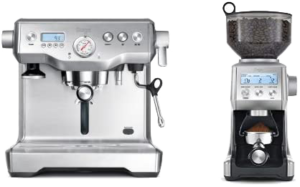
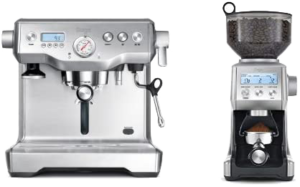
If you just want to get started with a grinder that will do the job, the Smart Grinder Pro will do that – and the best value for money in terms of RRP, would be the Dynamic Duo bundle from Sage. This gives you the Dual Boiler and the Smart Grinder Pro, for just £50 more than the Dual Boiler on its own. This is a £210 grinder, so this is great value.
While this absolutely isn’t the perfect grinder to pair with the Dual boiler, it’s absolutely fine to start out with, and it’s a bargain in this bundle when you’re only paying £50 for it.
There are some stonking bundles available at the moment, from Clumsy Goat, a roaster based just up the road from me, in Lancashire. For example:
Sage Dual Boiler & Eureka Mignon Specialita
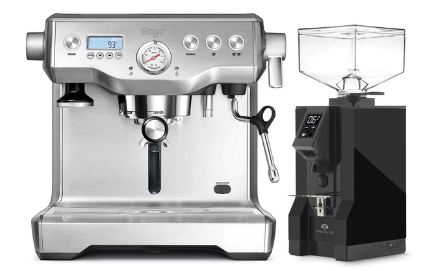
This seems too good to be true, it’s a bundle including a grinder I rate really highly as a pairing for the Dual Boiler, for less than the RRP of the Dual Boiler…
I don’t know how they can do this, and if it wasn’t for the fact that Clumsy Goat are a roaster with a decent reputation, I’d think this was one of those “looks too good to be true, probably is” scenarios, but this is legit – although I’m assuming it’s a temporary thing to clear some stock or something, I can’t imagine they’d be able to afford to do this all the time.
They’re doing similar bundles with the Eureka Oro, Mignon XL and loads more. Check them out:
But regardless of which grinder you’re going to use, I’d say if you’re buying the Sage Dual Boiler, and you don’t buy the Dynamic Duo while that means getting the smart grinder pro so cheap, you’re missing a trick.
What I’d suggest is that you either start out using the smart grinder pro with the Sage dual boiler, and then look at upgrading further down the line – or, even if you’re not planning to use the smart grinder pro with your dual boiler, get the Dynamic Duo package, and then either sell the smart grinder pro or use it for brew if you also use manual brew methods.
If you plan on re-selling it, that’s very easy to do – if you put it for sale brand new, unused, at the moment you’ll probably find that it sells very quickly at close to RRP, simply because they’re out of stock so often and they rarely come up new for sale online, so you can put that profit towards your chosen grinder.
If you also use manual brew methods, though, I’d highly recommend keeping the smart grinder pro and using it for this.
The smart grinder pro is great when it comes to very easily switching between brew methods, for example, it’ll have no problem jumping up to cafetiere grind and then right back down to stove top. You could use one grinder for espresso and for brew, but the problem with that is if you do way out of espresso range to use the grinder for brew, you’ll have to dial back in again, which isn’t ideal.
Oh go one then…..what was the link again for Coffeeworks I hear you say?
For more on grinders, see:
Is the Sage or Breville Dual Boiler being discontinued?
Before signing off, I just wanted to deal with this question, as it’s something I’ve read some rumours about. In fact, if you Google Breville Dual Boiler, you’ll find one of the predicted searches is “is the Breville dual boiler being discontinued?”.
The answer: No, this is a myth.
I think this has simply come from the fact that the machine was out of stock with most re-sellers for quite a while, particularly in the States I think, due to issues stemming from Covid.
We’ve seen this in the UK with various espresso machines, actually, the Dual Boiler has been in stock at Sage Appliances and largely available on Amazon in the UK most of the time over the past year or two, while machines like the Bambino Plus and the Smart Grinder pro have been out of stock quite a bit.
Anyway, it’s not true – I spoke to Sage Appliances, and they assured me that there are no plans to discontinue the Dual Boiler, which I’m very pleased about!
Life is like a box of chocolates, subscribe to my YouTube Channel, try my coffee at The Coffeeworks (use discount code CWNC25 for 25% off your first order), follow me on Twitter & Instagram, follow the coffeeblog FaceBook page, and that’s all I have to say about that.
Coffee Blog is proudly powered by WordPress